
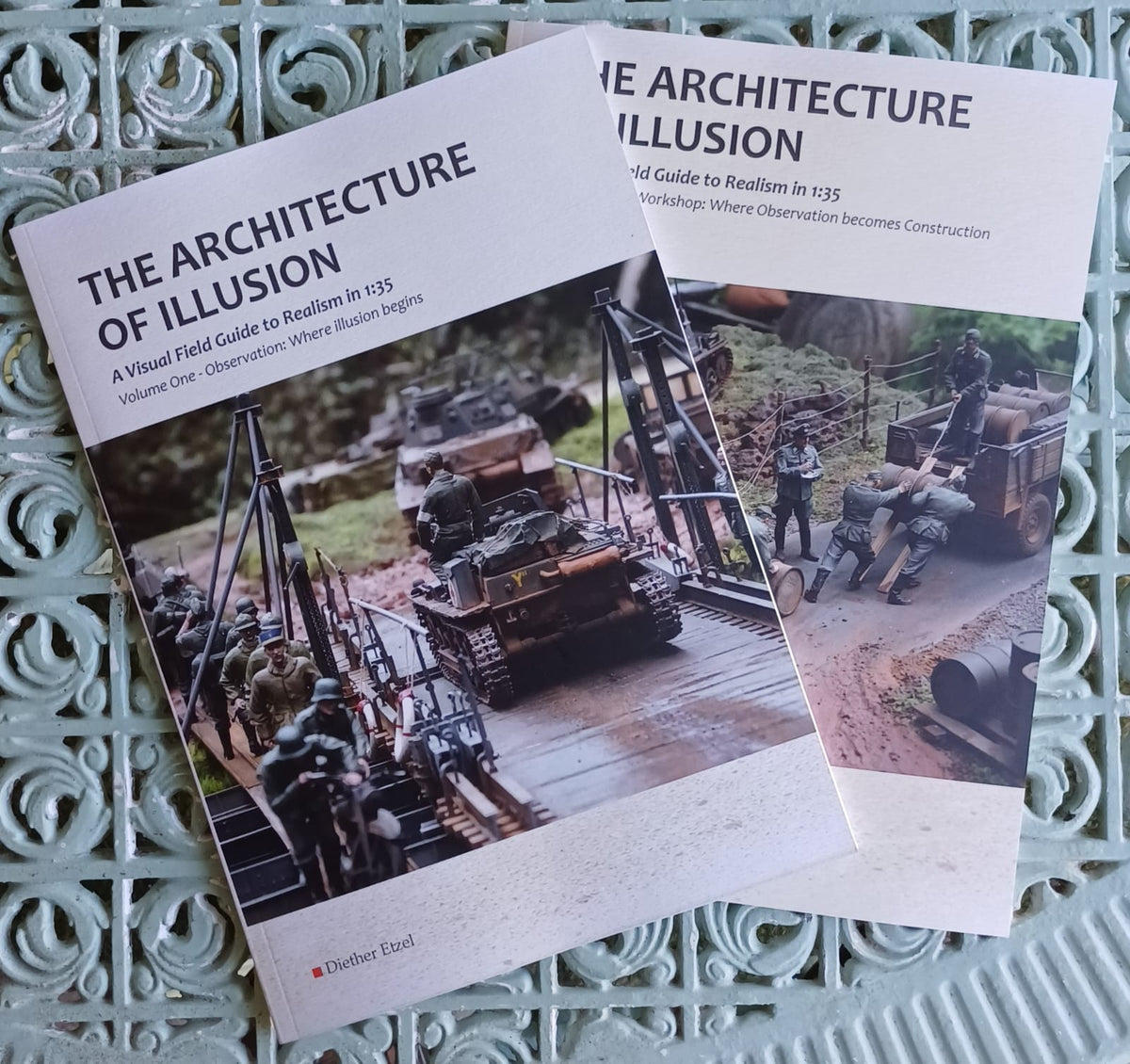
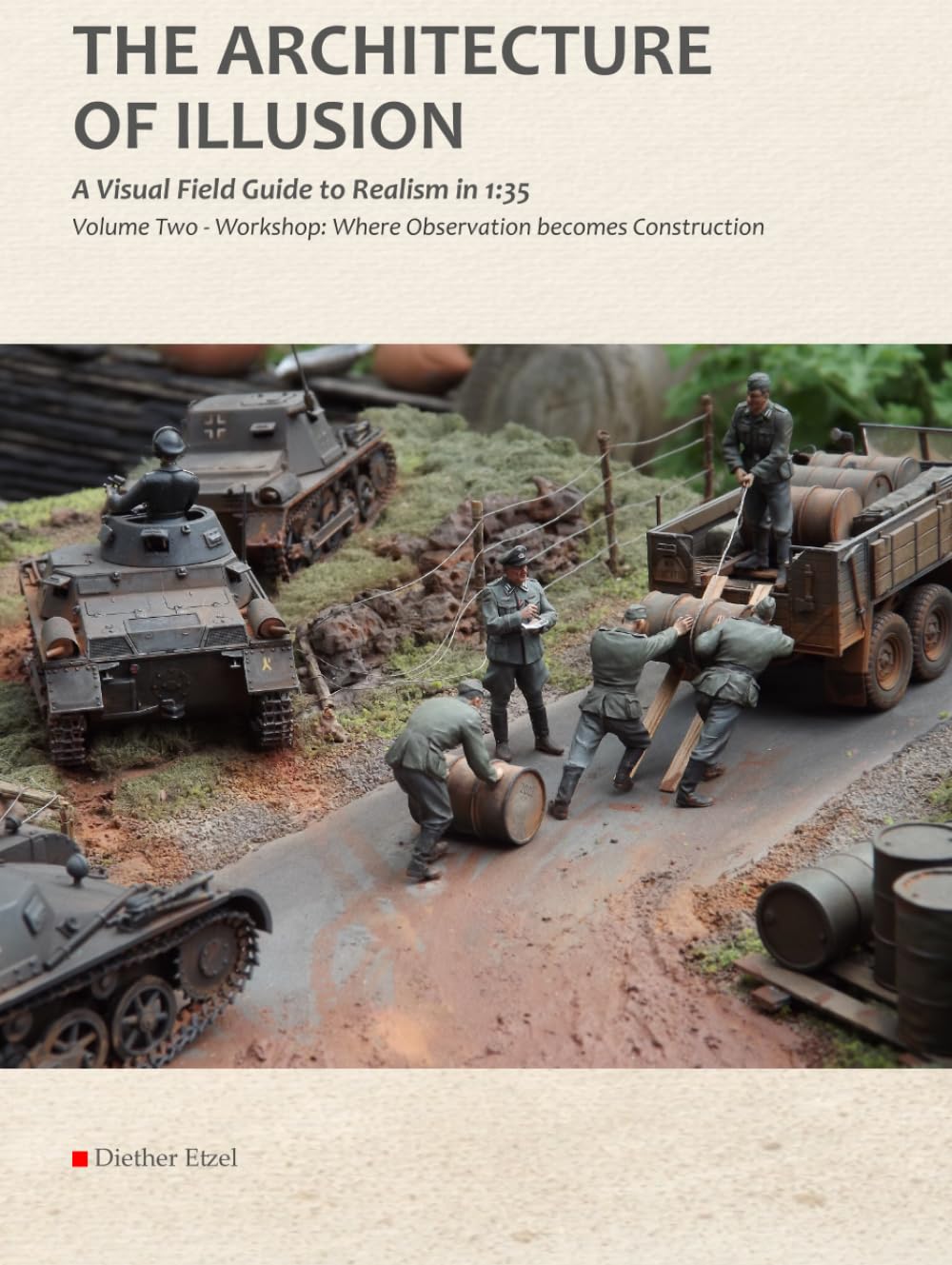
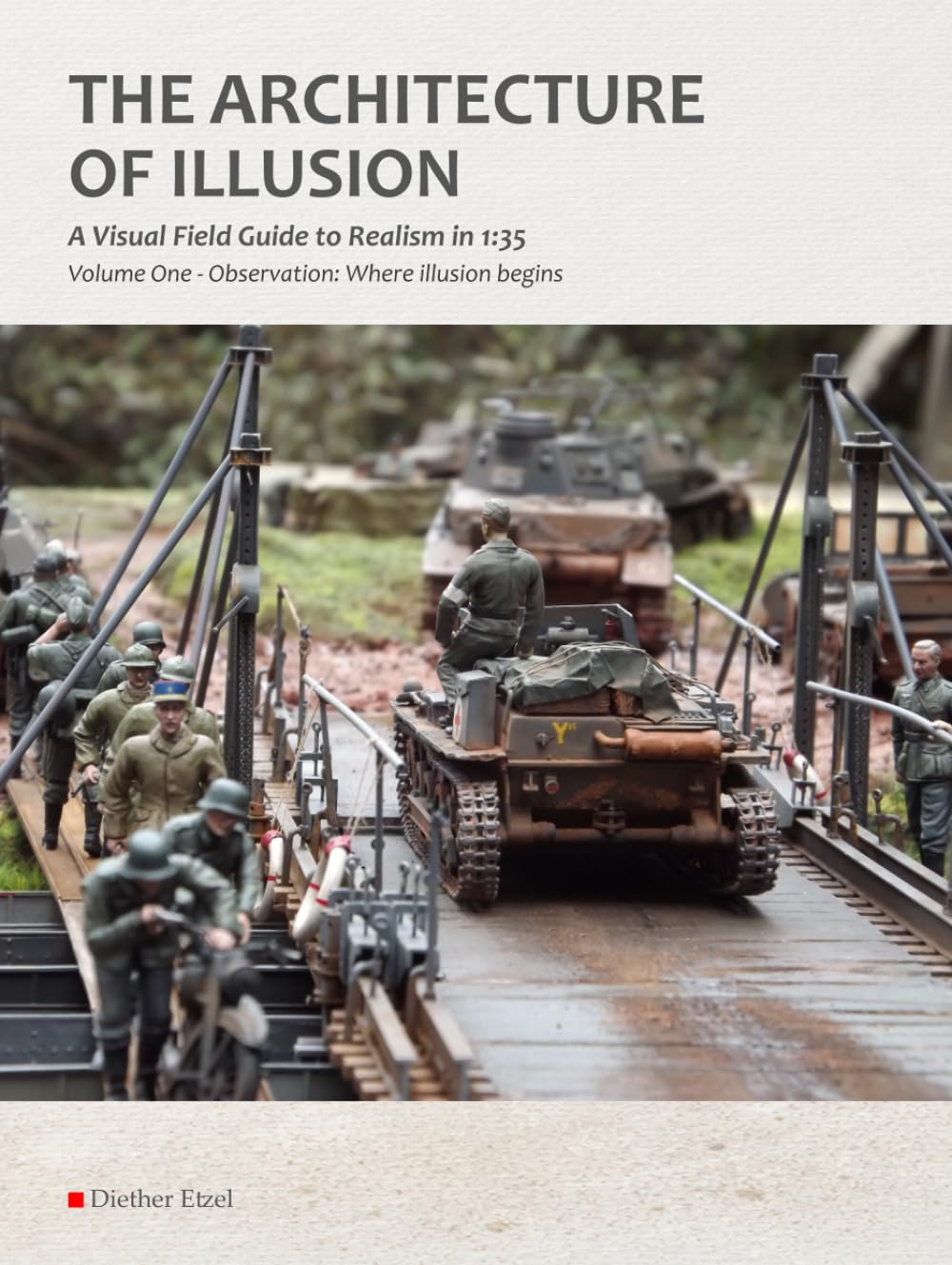


Description
The Architecture of Illusion – Volume One: Observation
Why do some dioramas immediately feel believable while others appear to be little more than models placed on a base?
The difference is rarely the model itself.
The difference lies in observation.
A convincing diorama is not simply an arrangement of objects. It is a small world governed by the same relationships that exist in the real one. Ground carries weight. Vehicles compress soil. Footsteps disturb dust and gravel. Vegetation grows where conditions allow it and disappears where activity prevents it. Objects are moved, used, abandoned, and weathered over time.
These quiet relationships are what the eye recognises as truth.
The Architecture of Illusion – Volume One: Observation explores the underlying logic that makes dioramas believable. Rather than focusing primarily on modelling techniques, this book examines how convincing scenes are constructed through careful observation of the real world.
Using numerous examples drawn from completed 1:35 scale dioramas, the book explains how terrain, figures, vehicles and structures must interact naturally if the scene is to feel authentic. Small decisions about placement, disturbance, weight and environment combine to create the illusion that the moment being depicted is part of a larger reality.
Topics explored in this volume include:
• Why groundwork is often the foundation of a successful diorama
• How terrain and objects must interact logically
• Understanding weight, disturbance and environmental consequence
• Observational details that bring miniature scenes to life
• The “second layer” of modelling — subtle additions that create narrative
Throughout the book, finished dioramas and small construction studies illustrate how these ideas translate into practice. Many of the techniques rely on simple, budget-friendly materials, often sourced from hardware stores or everyday objects. The emphasis is not on expensive tools or complex processes, but on understanding how believable scenes emerge.
The Architecture of Illusion is a series devoted to the art and structure of diorama building. Later volumes expand into workshop-style guides, step-by-step construction methods, terrain techniques, vegetation, and the practical creation of small environmental details.
But everything begins with observation.
Because the most convincing dioramas are not those that display objects.
They are the ones that quietly suggest that something has already happened there.
In Volume Two of Architecture of Illusion, Diether Etzel takes the reader beyond the basic techniques of scale modelling and into the far more demanding world of observation, interpretation, research, and reconstruction.
A convincing diorama does not begin with glue, paint, or commercially available parts. It begins with learning to see.
How was a building constructed? Why does one wall weather differently from another? What happens to plaster when it fails? Where does water collect? Why are some bricks irregular while others are perfectly uniform? What tiny details reveal how a building was built, repaired, occupied, and eventually aged?
Through practical examples, detailed observation, and lessons learned at the workbench, this volume explores how to translate those answers into miniature.
The journey culminates in Sant’Anna in Camprena, the Tuscan monastery made internationally famous as a principal setting for The English Patient. Reconstructing the monastery at 1:35 scale becomes an exercise in reading the evidence left behind by centuries of construction, repair, weather, and use.
This is not a book about simply copying what can be seen.
It is about discovering what must have happened — and then finding ways to make that history visible in miniature.
Volume Two is the journey towards the illusion.